On November 3, Canva CEO Melanie Perkins told staff that 1,271 roles would be affected by a restructure. That's 22% of a company of about 5,700 people in 37 countries, and Canva's first major redundancy round in 13 years (TechCrunch; AAP via Newcastle Herald).
Founders have asked us two questions since. What does a cut like this actually save? And what should a 50-person company learn from a 5,700-person one? This piece answers both, and ends with a worksheet you can copy into a spreadsheet.
All figures are in US dollars. The Canva numbers are our estimates from public reporting, and we show our working.
What happened
Not all 1,271 people are leaving. The figure covers people who exit, people whose roles change and people asked to relocate to "centralised hubs". Canva has not said how many jobs are actually cut (HCAMag; TheStreet).
The structure is changing. Product, Growth and Platform merge into one product organisation. Management layers are collapsed, and Sydney becomes the primary home for more product teams (B&T). From January 2027, most hybrid staff are expected in the office two to three days a week (TheStreet).
Canva says this is not AI replacing people. A spokesperson said the changes are "about setting Canva up to build those products, not using AI to do the work of people who are leaving" (AAP via Newcastle Herald). Perkins pointed to growth instead: "our growth has slowed for the first time in a decade" (TechCrunch).
AI is still in the background. In August, Canva cut its 2026 revenue growth forecast from about 30% to about 20%, partly because AI serving costs ran higher than expected (Startup Daily, August 2026).
The cost vs savings breakdown (our estimate)
Canva hasn't disclosed the cost of the restructure, the number of real exits or the mix by country and function. So we built a simple model with three scenarios. Every figure below is our rounded estimate, not a Canva number.
The assumptions
| Assumption | Low | Mid | High |
|---|---|---|---|
| Roles that actually exit (of 1,271) | 636 (50%) | 953 (75%) | 1,271 (100%) |
| Blended base salary (Australia, US, Philippines mix) | $95k | $110k | $125k |
| Fully loaded cost multiplier (super, payroll tax, benefits, equipment, space) | 1.25 | 1.30 | 1.35 |
| Severance | 6 months' base | 6 months' base | 6 months' base |
| Healthcare continuation per exit | $6k | $8k | $10k |
| Share taking the $10k grant | 40% | 60% | 80% |
| Share of the 1,271 relocating, at $35k each | 10% | 15% | 20% |
| Survivor productivity dip | 5% for 3 months | 7% for 4 months | 10% for 6 months |
| Extra survivor attrition (restructure plus office mandate) | +3 points | +5 points | +8 points |
| Exited roles later re-filled | 10% | 15% | 20% |
The severance, healthcare and grant inputs come from Canva's published package. Salaries are blended from Levels.fyi self-reported Canva pay and an Australian tech salary guide. The hidden-cost inputs are our judgment.
The results
| $ millions (our estimate) | Low | Mid | High |
|---|---|---|---|
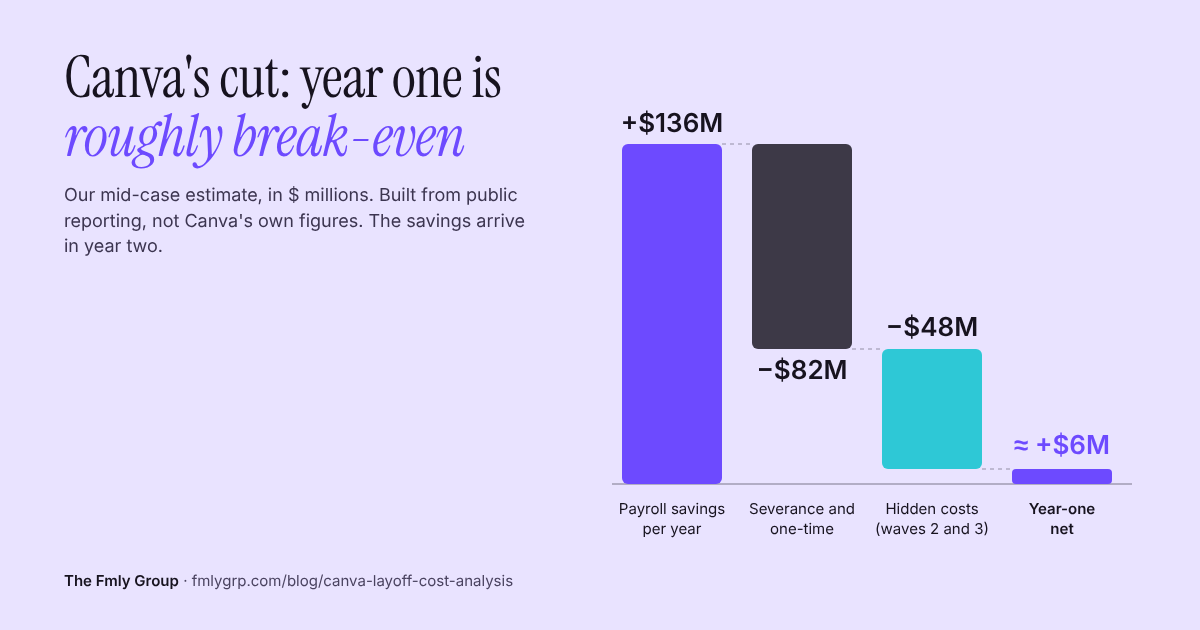
| Annual run-rate payroll savings | 76 | 136 | 214 |
| One-time direct costs (severance, healthcare, grants, perks, relocation, legal and admin) | 48 | 82 | 124 |
| Hidden costs in year one (productivity dip, extra attrition, re-hiring) | 19 | 48 | 107 |
| Year-one net | about +8 | about +6 | about -17 |
| Year-two net (savings only) | +76 | +136 | +214 |
| Payback including hidden costs | 10.7 months | 11.5 months | 12.9 months |
| Savings as a share of revenue | about 2% | about 3.5% | about 5.5% |

Severance is the biggest single cost: about $30M, $52M and $79M across the three cases. The figures assume a full year of savings from the day people exit, so notice periods and phased exits would push break-even later.
What the numbers say
Year one is roughly break-even. In all three cases, the first year's savings are mostly spent on severance, the transition and the hidden costs. The money arrives in year two, at somewhere between $75M and $215M a year.
The savings are small next to the growth gap. Ten points of lost growth on about $3.7bn is roughly $370M of revenue a year. That base is the AFR's reported annualised revenue, from leaked data Canva hasn't confirmed. Cutting cost protects margin. It does not bring growth back.
The swing factor is the second wave. In our high case, hidden costs nearly equal the direct ones. Every 100 extra regretted leavers adds about $8M. A 2002 meta-analysis found that after layoffs, survivors' job satisfaction fell 41% and job performance fell 20% (Greater Good, UC Berkeley).
Our read of the decision (opinion)
This section is our interpretation. Canva hasn't said most of this, and we may be wrong.
It reads as a margin and IPO-readiness move. Growth slowed, AI made each user more expensive to serve, and valuation marks fell from a $42bn peak to about $31bn to $35bn (Startup Daily). Canva has not tied the cuts to an IPO.
The AI link is real, but indirect. We take Canva at its word that AI isn't doing the work of the people leaving. But AI shaped the decision through the cost line.
Hubs and the office mandate are a second, unpriced filter. They save money and build density. They also tend to cost you the people with the most options, and that's the least predictable line in our model.
What we'll watch: Canva's next revenue disclosure, product release pace over the next two quarters, senior departures in early 2027 and whether similar roles quietly reopen. One SHL survey found 19.1% of US workers replaced by AI were later asked back (Fortune, November 2026).
What Canva got right: decide your severance before you need it
Canva's package is the part we'd tell every founder to copy. It was generous, and it reads as a deliberate choice rather than a scramble.
- At least six months' salary in every country, inclusive of statutory pay (People Matters). That compares with about 11 weeks on average in US tech (Challenger data via HR Brew).
- Twelve months of healthcare where Canva already provided it, and 12 months of its employee assistance program, extended to family.
- The vesting cliff waived for anyone who joined in the past 12 months.
- Practical help: people keep their MacBook, get career coaching and LinkedIn Premium, and can join an opt-in alumni talent directory.
- The CEO owned it. "I'm deeply sorry for the pain and disruption this will cause for everyone affected," Perkins wrote (TheStreet).
By our estimate, the package costs roughly $20M to $40M more than a more typical one. We think it was a good trade.
Why a generous package pays
Survivors watch how leavers are treated. Joel Brockner's research found that survivors' reactions depend heavily on how fair the layoff seems and how it's handled (California Management Review, 1992). In a later study, when survivors saw the process as fair, how bad the outcome was no longer predicted how negatively they reacted (Brockner and others, Academy of Management Journal, 1994).
Your employer brand outlasts the news cycle. "Candidates remember how a business treated them on the way out long after they've moved on," one recruiter told HCAMag. Perkins's post drew thousands of mostly warm reactions, and other companies used the thread to offer jobs (Fast Company).
Our view on the rest. We haven't found solid public data tying severance size to eNPS or Glassdoor ratings, so treat this as experience, not evidence. People who leave well tend to refer candidates, return as boomerang hires and say kind things in public reviews. Survivors who see a fair exit are less likely to start job hunting. And a clear, generous offer, paired with a signed release where that's lawful, makes disputes less likely.
The math backs this up at small scale too. In the worksheet below, moving from 12 weeks to six months of severance costs about $390k. That's roughly what four regretted departures cost to replace.
Review your package now, before you ever need it
Write this down in a calm quarter, not the week of a cut. Here is where we'd start. Your lawyer checks the local minimums.
| Element | What to decide | Our starting point |
|---|---|---|
| Severance by tenure | Weeks of base pay per year of service, with a floor and a cap | 4 weeks plus 2 per year of service, floor 8 weeks, cap 26 weeks, never below statutory minimums |
| Severance by level | Whether leaders get more, since their search takes longer | 4 extra weeks for director level and above |
| Healthcare | Months of premiums you'll cover | The full severance period, or at least 3 months |
| Equity | Cliff, vesting and exercise window | Waive the cliff or vest pro rata to the exit date, and extend the exercise window beyond the usual 90 days (check the tax effect on US incentive stock options) |
| Laptop and kit | Keep or return | Keep the laptop once it's wiped |
| Outplacement | Coaching, CV help, intros | A budget per person, plus founder intros to your network |
| References | Who gives them and what they say | A written reference policy, and a named contact for every leaver |
| Alumni | How you stay in touch | An opt-in alumni list you share with hiring friends |
Not everyone praised Canva. A union welcomed the entitlements but asked big tech to be "honest about the impact that AI is having on jobs" (AAP via Newcastle Herald). And for the people affected, a good package doesn't make it a good week.
Model it before you decide: a founder's worksheet
Most cut plans count the savings and stop. Here is the full model in plain words, so you can copy it into a spreadsheet. A downloadable template is on the way.
The formulas
- Run-rate savings = roles cut × base salary × loaded multiplier (taxes, benefits, tools and space, often 1.2 to 1.4).
- Severance = roles cut × (base ÷ 52) × weeks of severance under your policy.
- Notice pay = roles cut × (loaded cost ÷ 52) × weeks of notice or pay in lieu.
- Benefits = roles cut × monthly premium × months you cover.
- Kit, outplacement, legal and admin = per-person costs plus a fixed estimate. Track equity changes too. They're usually dilution, not cash.
- Wave 2, survivor attrition = survivors × extra regretted attrition rate × base × replacement cost (often 50% to 100% of base).
- Wave 3, rehiring = roles you re-fill × (recruiting plus ramp cost), plus their pay for the months they're back.
- Productivity dip = survivor loaded payroll × dip % × months ÷ 12.
- Year-one net = run-rate savings minus direct costs (2 to 5) minus hidden costs (6 to 8).
- Payback in months = total one-time and hidden costs ÷ (run-rate savings ÷ 12).
A worked example (hypothetical)
An illustrative 80-person company cutting 12 roles at $120k base. Every input is an assumption for teaching, not a benchmark.
| Line | How we got it | $ |
|---|---|---|
| Run-rate savings | 12 × $120k × 1.25 | 1,800,000 |
| Severance, 12 weeks | 12 × ($120k ÷ 52) × 12 | -332,000 |
| Notice, 4 weeks | 12 × ($150k ÷ 52) × 4 | -138,000 |
| Healthcare, 6 months | 12 × $1,170 × 6 | -84,000 |
| Laptops and outplacement | 12 × $3,000 | -36,000 |
| Legal and admin | Fixed estimate | -25,000 |
| Direct costs | -615,000 | |
| Wave 2: 3 regretted leavers | 68 survivors × about 5%, × $120k × 75% | -270,000 |
| Wave 3: 2 roles re-filled from month 7 | 2 × $90k recruiting and ramp, plus 6 months' pay | -330,000 |
| Productivity dip | 68 × $150k × 7% × 4 ÷ 12 | -238,000 |
| Hidden costs | -838,000 | |
| Year-one net | +347,000 | |
| Payback | $1.45M ÷ $150k a month | about 10 months |
| Year-two savings | 10 roles still out × $150k | 1,500,000 |
Sensitivity: every extra regretted leaver costs about $90k. Six months' severance instead of 12 weeks takes year one to roughly break-even (about -$41k). A rough case (5 leavers, 3 roles re-filled, a 10% dip for six months) gives about -$271k.
The point isn't the exact number. It's that hidden costs can be bigger than the severance, and they're the part you can still influence.
Before you set a date
This is general information, not legal advice.
- US federal WARN: employers with 100 or more employees generally owe 60 days' written notice before a mass layoff (U.S. Department of Labor).
- California (Cal-WARN): applies to establishments with 75 or more employees. From January 1, 2027, notices for layoffs caused in whole or in substantial part by AI must say so (Foley & Lardner).
- Australia: redundancy pay runs from four to 16 weeks by length of service for employers that aren't small businesses, and consultation may be required (Fair Work Ombudsman).
Also list the people you can't afford to lose and ask what the change means for each of them. If year one comes out near zero, ask whether a hiring freeze or slower backfill gets you most of the way with less risk.
How to build this mindset into your culture
The best time to plan a layoff is when you don't need one. These habits make cuts rarer, and fairer when they happen.
- Set the severance policy in calm times and publish it internally. People trust a rule that existed before the cut more than an offer made during it.
- Make workforce planning a quarterly habit. Review roles, cost and the hiring plan every quarter, so a big correction is less likely.
- Keep the hiring bar high. Every role you didn't need to fill is a role you'll never need to cut.
- Be honest about the reason. If it's growth or margin, say so. Don't blame AI if it isn't the cause, and say what AI is and isn't doing. We cover why in our piece on companies rehiring roles they cut for AI.
- Train managers for hard conversations. Rehearse the first five minutes, what to say and what not to promise.
- Keep a communication plan template on file. Who hears first, who tells them, what happens in the next hour, how long leavers keep access and what the people who stay hear, and when.
What to do with the savings
A cut only works if the money goes somewhere on purpose. You have four main options.
| Option | When it's the right call |
|---|---|
| Extend runway | Cash is under 18 months, or the next raise is uncertain |
| Reinvest in growth | You cut to refocus, and the new bet is clear and funded |
| Retain key survivors | Your critical people have options and the risk of a second wave is high |
| AI and tooling for remaining teams | Workload stayed the same and specific tools would help fewer people do it well |
Our order of priority: retention of key survivors first, runway second, then tools, then growth bets. A growth bet that loses its best people won't land.
Our rule of thumb: don't commit more than half of year-one savings until month six. Ring-fence about 10% for retention of the people you can't lose, such as stay bonuses, promotions you'd planned anyway and visible development. Hold the rest of that half as a buffer for hidden costs. In the worked example, that's $180k for retention and $720k held back. Release what's left after the six-month review.
Tell the team where the money is going. Say it in the same week as the cut, in plain numbers where you can. "We're extending runway to 24 months and investing in the people here" is far more reassuring than silence.
FAQ
How many people did Canva lay off in November 2026?
Canva said 1,271 roles were affected, 22% of its workforce. That includes role changes and relocations to hubs, not only exits. Canva has not said how many jobs are actually cut.
Was Canva's layoff caused by AI?
Canva says no. A spokesperson said the changes are not about using AI to do the work of people who are leaving. Higher AI serving costs were one reason Canva cut its 2026 growth forecast in August, though.
How much will Canva save from the restructure?
Canva hasn't said. Our estimate is $75M to $215M a year in payroll once the changes settle. After severance and hidden costs, year one is roughly break-even.
What was in Canva's severance package?
At least six months' salary in every country, 12 months of healthcare where Canva provides it, a waiver of the one-year vesting cliff for recent hires, career support and $10,000 grants to start a business or community project.
How much severance should a startup offer?
There's no single right number, and local law sets the minimum. Our starting point is four weeks plus two per year of service, with a floor of eight weeks and a cap of 26, plus healthcare for the same period. Decide it before you need it.